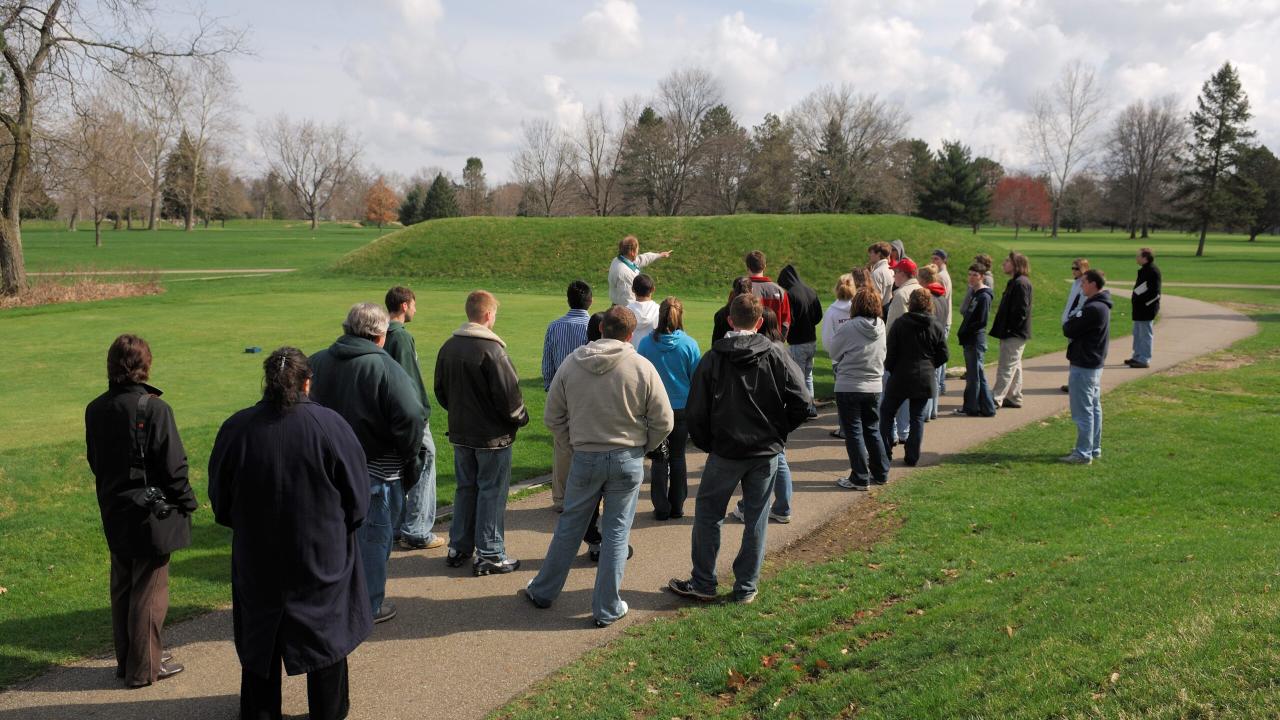
Newark Earthworks, Ohio History Connection
These enormous earthen enclosures connected by walled roadways were spread across more than four square miles now in Licking County Ohio. Building the Newark complex 2000 years ago, the Hopewell peoples had to move more than 7 million cubic feet of earth with baskets, hoes, and no heavy machinery. Outside the Great Circle gateway and to the north and east are well-preserved remains of the low embankment walls that once encircled the entire Newark complex with a continuous outline. There seem to be only three entry points, all of them suggesting ceremonial approaches from water. Once inside, the people were channeled from one specialized enclosure to another. This area of Licking County was a prairie at the time of building with hardwood forests in the distance based on past pollen analysis.
From the Square, the view across the highway to the northeast will help in grasping the scale of the earthwork complex as a whole: the center of the giant Ellipse was half a mile away. Each piece of the Newark complex seems to have had a special use and meaning, and this Ellipse was the cemetery of the American Indian earthwork’s builders – a necropolis probably as grand as Mound City in Chillicothe. Eleven conical mounds surrounded a large, irregular one at the center. One set of burials here was covered in sheets of gleaming mica. Some of these mounds were probably already very old before being surrounded by the elliptical wall: perhaps adding this new order was another way to honor the ancestors. The ellipse and its mounded tombs were destroyed very early by the construction of the canal and the railroads, and the growth of the town. Old records prove that builders and looters came across objects made of copper and other precious materials. Yet today, the only thing we know came from this area is the extraordinary “Shaman of Newark.”
Ellipses, squares, octagons, circles, parallel walls: The American Indian builders of ancient, monumental Newark clearly knew how to lay out huge geometric shapes with great precision. These specific earthworks shapes used common dimensions. The diameter of the Observatory Circle forms a square inscribed in the Octagon. Laid out six times, it marks the distance to the Great Circle, or that from the Octagon to the Square. The Great Circle and the Wright Square have equal perimeters. The area of the Wright Square and Observatory Circle of the Octagon Earthworks is equal. And the imagined on-point square in the center of the Octagon of the Octagon Earthworks matches the area of the Great Circle. The difference in area between the Great Circle and the Observatory Circle of the Octagon Earthworks has been suggested to be the same proportional difference of the Moon at perigee, closest to us during a supermoon, and at apogee, when the moon is the farthest from us.
Administered by the Ohio History Connection. In 1964 the Newark Earthworks was designated as a National Historic Landmark. In 2006 the Newark Earthworks was then designated as the "official prehistoric monument of the State of Ohio."
Newark Earthworks GIS Web Map [external link]. This image was georeferenced and traced for the purpose of understanding the archaeological site in Newark, Ohio and creating experiential materials including: 1. Screen-based, 2. Mobile, and 3. Planetarium panoramas for Tribal citizens, students, teachers, SciDome visitors, and researchers. Created in conjunction with the Office of Digital Humanities, National Endowment for the Humanities, Ball State's Institute for Digital Intermedia Arts (IDIA Lab), Applied Anthropology Laboratories (AAL), The Works, Ohio History Connection, Eastern Shawnee Tribe of Oklahoma and the Shawnee Tribe. Marti Chaatsmith and Megan Cromwell consulted with project members during this grant.
Octagon Earthworks, Newark
Two combined earthwork enclosures positioned above the floodplain of Raccoon Creek. This earthwork includes a 20-acre circle and a 50-acre octagon, connected by a short passageway. Aligns with the 18.6 year long cycle of the moon. Across town from the Great Circle (once linked by ancient walled roadways, now by 21st Street, Main Street, and 33rd Street) the precise Octagon Earthworks present their perfectly level artificial horizons, used to mark the complex movements of the moon. A giant circle connects via a parallel-walled avenue with the even larger octagon, with cleverly designed corner doorways. Small earthen walls nearby were the beginning of a long straight roadway to the southwest. This octagon and its adjoining circle are the most precise of all the remaining earthworks. They’re a half-mile across, perfectly formed, and exactly level. The circle’s diameter is 1,054 feet (321 meters), an interval that also perfectly constructs the Octagon (defining a diagonal square that perfectly touches 4 gateways). Throughout the site, the walls are just at eye-level, keeping us enclosed, and forming an artificial horizon. Walking the grounds takes one to three hours.
The Octagon Earthworks was purchased from the State of Ohio by taxes from the citizens of Newark for a public park in 1908. It was a private golf course from 1910 until December 31, 2024.
Address: 125 N 33rd Street, Newark, OH 43055
The site is fully open to the public, dawn to dusk and has bus parking. The visitors center contains a museum store, some interpretive materials, and roughly six restroom stalls for two genders.
Knowlton School of Architecture and NEC exhibit "Monuments of the Ohio Valley" is inside the Visitors Center upstairs to the left.
Great Circle, Heath
A 1990s excavation through the Great Circle wall has shown how part of the construction was done. First a set of point mounds were placed around in a circle. Then a ditch was dug, and that soil was used to make a ring. Finally, yellow gravelly clay was brought up from deep pits nearby to cover the inside. Building techniques probably had both spiritual and practical meaning: The yellow clay smoothed and supported the inner wall, but the color also made for a more dramatic ritual space. The ditch provided earth for the wall, but it also may have filled with water in wet seasons. It has been suggested into the 1800s that this deep ditch might have been lined with stone. External to the circle was a redder earth.
At the center of the circle is an elegantly undulating earthen memorial built over the remains of a long, timber-framed building with two “wings.” When it was excavated in 1928, a pattern of post molds showed a long building, with screen-walls extending from it like two wings. Inside, a rectangular clay basin held fires, potentially preparing people for burial. Scraps of shiny mica littered one end of the floor. When they were finished using the building, the people filled the fire basin with white sand and left little behind except a pair of copper shapes. They dismantled the wooden structure or burned it and covered its floor with earth.
The Great Circle Earthworks was purchased in 1854 by local residents as the Licking County Fairgrounds, it was leased as an amusement park and racetrack from 1897 until 1932.
Address: 455 Hebron Road, Heath, Ohio 43056
The Great Circle has a museum with two restroom stalls, a small museum store, and bus parking. The Great Circle also has a non-reservable outdoor picnic shelter with tables.
Wright Square
A few blocks away lies a fragment of Newark’s ancient earthen square, the Wright Earthworks, at Grant Street near James, viewable from James Street (accessible via 21st Street; drive around the Great Circle and head north). The Square was originally about the size of nine city blocks. Eight small mounds inside its gateways emphasized its geometric precision. Much of the square and the surrounding lines were destroyed, some as early as the 1820s, when the Ohio Canal was cut through here. Less than 20 years later, Squier and Davis reported: "The ancient lines can now be traced only at intervals, among gardens and outhouses... A few years hence, the residents upon this spot will be compelled to resort to this map, to ascertain the character of the works which occupied the very ground upon which they stand."
The Wright Earthworks were donated to the Ohio Historical Society (now the Ohio History Connection) in 1934 by Mrs. Frances Rees Wright.
Address: 158 James Street, Newark, Ohio 43055.
The preserved corner is past Waldo Street intersection, the park across from Modern Welding.